



GLOBAL & BILINGUAL EDUCATION
Global Me is a socioconstructivist school, inspired by the ideas of Piaget, Vygotsky, and Loris Malaguzzi (Reggio Emilia). We believe that children are protagonists in their own learning process. Teachers, peers, and school environments all play a fundamental role in this process. Our partnership with families is also essential as we work toward our goal of nurturing globally minded individuals. Every child has a world within them, and it is this potential that we seek to bring out in each of our students.
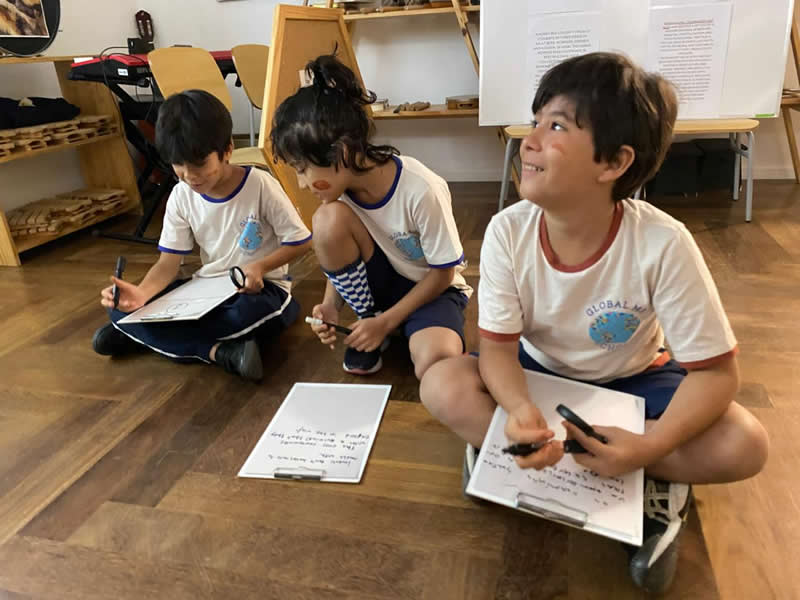
THE LEARNING PROCESS
At Global Me, English is introduced through immersion. Our students experience the second language in meaningful contexts and acquire it naturally through the needs and interactions created by the learning experiences proposed by our specialized teachers. Throughout their years at Global Me, children develop fluency in English through periods of language immersion. Families can choose the schedule that best suits their children: half-day, extended half-day, or full-day.
WE ARE AN IB WORLD SCHOOL
We are an IB World School authorized to offer the IB Primary Years Programme (PYP) — an international recognition that reinforces the excellence of our educational approach. This authorization confirms that our school meets the high standards of the International Baccalaureate, one of the world’s most respected educational organizations, recognized for developing curious, critical, ethical students who are prepared to meet the challenges of the 21st century. More than a methodology, the IB PYP is a way of learning and teaching through inquiry, critical thinking, collaboration, reflection, and connections to the real world. We continue to move forward with purpose, consistency, and responsibility, placing students at the center of learning and preparing our children for life, both today and in the future.
The Reggio Emilia approach that inspires us is an educational philosophy that originated in the city of Reggio Emilia, Italy, and was developed by Loris Malaguzzi. Centered on listening to and respecting children, it values their active role in the learning process. It is based on the understanding that children are curious, creative, and capable of constructing their own knowledge through interactions with their environment, peers, and adults. The teacher acts as a facilitator and co-learner, encouraging inquiry, expression, and reflection. The school environment is also considered a “third teacher”, thoughtfully designed to inspire discovery and experimentation.